⇑
A R C H I V A L S O U R C E S
-
The
Top Short-Term Threat to Humanity: The Fuel Pools of Fukushima,
WashingtonsBlog, 7 Apr 2012
-
Fuel
Pool 35 Miles from Major American City [ie, Boston] – which Is Highly Vulnerable
to Earthquakes – Contains More Radioactive Cesium than Released By Fukushima,
Chernobyl and All Nuclear Bomb Tests COMBINED,
WashingtonsBlog, 12 Apr 2012
-
Fukushima Daiichi Site: Cesium-137
is 85 times greater than at Chernobyl Accident, by Akio Matsumura, Akio
Matsumura, 3 Apr 2012
-
How Dangerous is the Radioactive Wave Headed Toward the US?,
YouTube, published 6 April 2012 by TheBigPictureRT
-
Fukushima...radiation so high - even robots not safe,
YouTube, 30 March 2012
Kevin Kamps, Beyond Nuclear joins Thom Hartmann. More than a year
into the nuclear crisis at Fukushima - radiation levels have now
reached their highest point yet. What does all this mean - and what
should nuclear supporters in America be taking away from the continuing crisis?
-
Tokyo Soil Samples Would Be Considered Nuclear Waste In The US,
Arnold Gundersen, Fairewinds Energy Education, 25 March 2012
-
Why Nuclear Scientists Have Missed the Danger of Spent Fuel Pools,
by Dr. Gordon Edwards, Akio Matsumura, 23 January 2012
|
Local Copy on ratical.org
|
|
 20 March 2011: aerial photo taken by a small unmanned drone and released
by AIR PHOTO SERVICE of crippled Fukushima Dai-ichi nuclear power plant
in Okumamachi, Fukushima prefecture, northern Japan. From right to left:
Unit 1, Unit2, Unit 3 and Unit 4. (Air Photo Service Co. Ltd., Japan)
20 March 2011: aerial photo taken by a small unmanned drone and released
by AIR PHOTO SERVICE of crippled Fukushima Dai-ichi nuclear power plant
in Okumamachi, Fukushima prefecture, northern Japan. From right to left:
Unit 1, Unit2, Unit 3 and Unit 4. (Air Photo Service Co. Ltd., Japan)
|
Selected internet film listing of items soon after Fukushima went critical
Information Updates on Nuclear Power Plants in Fukushima
from Japan Atomic Industrial Forum, Inc.

20 March 2011: aerial photo taken by a small unmanned drone and released
by AIR PHOTO SERVICE of damaged Unit 4, left, and Unit 3 of the
crippled Fukushima Dai-ichi nuclear power plant
(Air Photo Service Co. Ltd., Japan)
|
Status of the Nuclear Reactors at the Fukushima Daiichi Power Plant,
New York Times, 03-16-11 (updated to 04-29-11), With timelines of the six reactors
Updated to April 29
Reactor 1
Outer building is damaged and it is presumed that there was a partial meltdown. Small amounts of radioactivity have been vented. Reactor has 400 fuel assemblies, the spent fuel pool has 292.
Reactor 2
Partial meltdown is presumed to have occurred. The primary containment vessel is cracked and some radioactivity has vented. Reactor has 548 fuel assemblies, the spent fuel pool has 587.
Reactor 3
The reactor used uranium and plutonium, which may produce more toxic radioactivity. The spent fuel pool may have become uncovered. Reactor has 548 fuel assemblies, the spent fuel pool has 514.
Reactor 4
Spent fuel rods in a water pool may have become exposed to air, emitting radioactive gases. An explosion and fire have damaged the building. No fuel assemblies in reactor; 548 were removed for maintenance and are part of 1,479 in spent fuel pools.
Reactor 5
The reactor is shut down and the building is not damaged. But there is concern that spent fuel in the building may become exposed to air. Reactor has 548 fuel assemblies, the spent fuel pool has 826.
Reactor 6
The reactor is shut down and the building is not damaged. But there is concern that spent fuel in the building may become exposed to air. Reactor has 764 fuel assemblies, and there are 1,136 in spent fuel pools.
Simulations of atmospheric dispersion of the plume formed by the release of the Fukushima Daiichi Nuclear Power Station, between March 12 and March 19, 2011
Published on 03-17-11 from the INSTITUT DE RADIOPROTECTION ET SÛRETÉ NUCLÉAIRE (
IRSN), the French Government’s official agency on radiation and nuclear matters.
The dispersion of radioactive releases into the atmosphere
IRSN simulated atmospheric dispersion of releases estimated between 12 and 20 March, using its numerical model applicable to long distance (scale of several hundred kilometers), using weather forecasts provided by Météo France.
This simulation was applied to the cesium 137, as a tracer of the plume during this period. The results of this simulation, conducted every hour from 12 March, are expressed in becquerels of cesium-137 per cubic meter of air (Bq / m 3). For comparison, values measured near the Chernobyl plant, shortly after the accident on April 26, 1986, exceeded 100 000 Bq / m; they were in the range of 100-1000 Bq / m 3 in the country most affected by the plume (Ukraine, Belarus); France, values measured in the east were the order of 1 to 10 Bq/m3 (May 1, 1986).
At the time this was made, a very low activity of cesium-137 remains in the air, on the order of 0.000001 Bq/m3.
SEE PLUME SIMULATION
Estimation of doses likely to be received by persons exposed to radioactive plume
Simulation:
Whole body dose may be received by a child of 1 year in the absence of protection for releases
Simulation:
Dose to thyroid likely to be received by a child of 1 year in the absence of protection during emissions

20 March 2011: aerial photo taken by small unmanned drone and
released by AIR PHOTO SERVICE of the crippled Fukushima Dai-ichi nuclear
power plant. From right to left: Unit 1, Unit 2 and Unit 3.
(Air Photo Service Co. Ltd., Japan)
|
Satellite Images at Institute for Science and International Security (ISIS, Wash., DC):
Emergency Special Report: Japan’s Earthquake, Hidden Nuclear Catastrophe
by Yoichi Shimatsu,
Global Research, 13 March 2011
Yoichi Shimatsu currently with Fourth Media (China) is former editor of the
Japan Times Weekly, has covered the earthquakes in San Francisco and Kobe, participated in the rescue operation immediately after the Indian Ocean tsunami in 2004 and led the field research for an architectural report on structural design flaws that led to the tsunami death toll in Thailand.
Recording: Citizens’ Nuclear Information Center (CNIC) press conference at the Foreign Correspondents Club of Japan:
The Earthquake and Nuclear Disaster In Tohoku
2011 Mar 13, 19:30-21:30
CNIC held a press conference in Japanese with English interpreting at the
Foreign Correspondents Club of Japan. Speakers included nuclear experts
associated with CNIC who are analyzing the unfolding disaster at the
nuclear power plants in Fukushima:
Hideyuki Ban, CNIC Secretary General,
Masashi Goto, Former Nuclear Power Plant Designer,
Chihiro Kamisawa, CNIC Senior Researcher.
The Citizens’ Nuclear Information Center is an anti-nuclear public interest
organization that seeks to provide reliable information and to educate
the public on the hazards of nuclear power. Hideyuki Ban is also the
antinuclear activist on the committee advising the government concerning
its Long-Term Program for the Utilization of Nuclear Energy.
Before and after photos of exploded reactor containment building in Japan
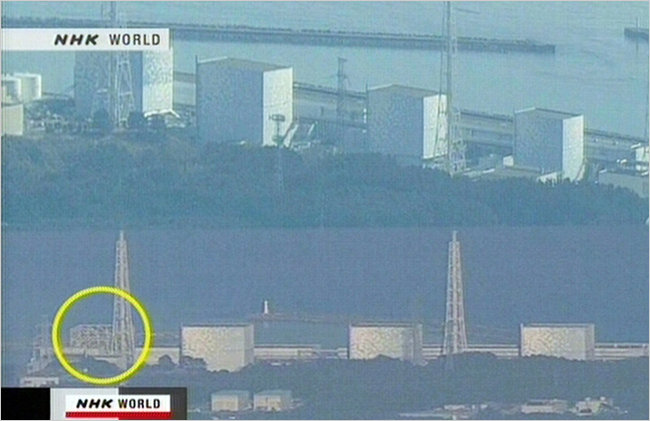
Fukushima vs. Three Mile Island from Three Mile Island Alert
Background: March 12, 2011
The crippled Fukushima reactor is a grim reminder of the Three Mile Island crisis. It has some common technical and safety aspects, and brings to mind broken promises by the industry to resolve open safety issues. The Japanese crisis certainly demonstrates the propensity for obfuscation by the industry while the public is left sifting through hundreds of media reports.
The first indication that the Fukushima reactor was in serious trouble came from reports that the Japanese military was flying batteries to the plant. This clue made it clear that the operators were having more problems than just trouble with circulating reactor coolant. It revealed that the operators were losing or had lost electrical control of the reactor systems and that the emergency diesel generators were not working. But the Japanese government and the industry continued to downplay the dire conditions facing them.
This same pattern of denial happened here at Three Mile Island leaving the citizens and their governor bewildered and confused. In fact, radioactive releases at TMI are presently being reported as a miniscule amount of radiation. At least 13 million curies of radiation were released. So it is easy to see how the Japanese crisis brings back various details of the TMI crisis.
Here are some of the similarities and differences:
http://www.efmr.org/files/TMIA_Japan_accident.pdf
The Citizens’ Nuclear Information Center (CNIC) is deeply concerned for the health and safety of the people affected by the earthquakes and tsunamis that have struck Japan over the last two days. We are particularly concerned for the people in the vicinity of nuclear power plants, including workers who are trying to minimize the scope of the disaster.
Unit 1 of the Fukushima Daiichi Nuclear Power Plant is in a state of meltdown. A nuclear disaster which the promoters of nuclear power in Japan said wouldn’t happen is in progress. It is occurring as a result of an earthquake that they said would not happen.
This could and should have been predicted. It was predicted by scientists and NGOs such as CNIC. We warned that Japan’s nuclear power plants could be subjected to much stronger earthquakes and much bigger tsunamis than they were designed to withstand.
Besides the question about how this accident will unfold, the big question now is, will the government and the nuclear industry acknowledge its mistakes and change track?
Last December the Japanese government began a review of its nuclear energy policy. The review was commenced in the spirit of essentially confirming the existing policy. That approach is no longer viable. The direction of the policy review must be completely reversed. It must be redirected towards developing a policy of phasing out nuclear energy as smoothly and swiftly as possible.
Philip White
International Liaison Officer
Citizens’ Nuclear Information Center
Phone: 81-3-3357-3800 (office)
Phone: 81-3-3708-2898 (home)
Web (will be update on Monday):
http://cnic.jp/english/
List
of US reactors with same weak containment design as Fukushima
Beyond Nuclear, 12 March 2011
General Electric Boiling Water Reactor MARK I Containments (24 units) in U.S.:
- Browns Ferry 1, 2 and 3, Decatur, AL
- Brunswick 1 & 2, Southport, NC
- Cooper, Brownville, NE
- Dresden 2 & 3, Morris, IL
- Duane Arnold, Palo, IA
- Edwin Hatch 1 & 2, Baxley, GA
- Fermi 2, Monroe, MI
- Hope Creek, Artificial Island, NJ
- Fitzpatrick, Scriba, NY
- Millstone 1, Waterford, CT
- Monticello, Monticello, MN
- Nine Mile Point Unit 1, Scriba, NY
- Oyster Creek, Lacey Township, NJ
- Peach Bottom 2 & 3, Delta, PA
- Pilgrim 1, Plymouth, MA
- Quad Cities 1 & 2, Cordova, IL
- Vermont Yankee, Vernon, VT.
See Also: Fukushima Dai-ichi Unit 1 reactor schematic and description at Beyond Nuclear.
NRC list: Find Operating Nuclear Power Reactors by Location or Name
In 1986, Harold Denton, then the NRC’s top safety official, told an industry trade group that the "Mark I containment, especially being smaller with lower design pressure, in spite of the suppression pool, if you look at the WASH 1400 Safety Study, you’ll find something like a 90% probability of that containment failing." Denton has previously "served" as the NRC’s point man sent into Three Mile Island Unit 2 reactor control room in the first hours and days of the 1979 meltdown accident.
Vermont Yankee, just two-three days ago, got a 20 year license extension from the US Nuclear Regulatory Commission, effectively overriding the deep and broad opposition to the license extension, from the Democratic Governor Peter Shumlin, to the State Senate which voted a year ago by 26 to 4 to shut down the reactor, all the way to grassroots environmental activists across the state. Obviously, the Vermont Yankee containment is questionable now -- it’s been questionable for decades. While earthquakes may be considered rare in Vermont, they are not unheard of, or beyond the realm of possibility. But of course there are other pathways for accidents, or attacks, at Vermont Yankee, that could end in similar results as what is unfolding at Fukushima Daiichi nuclear power plant -- from age related degradation at the 40 year old Vermont Yankee atomic reactor causing systems, structures, or components to fail, to an intentional attack on the fragile, flimsy facility.